In the mobile machinery market, competitive advantage is defined by speed and informed
decision-making. OEM equipment manufacturers constantly face the same dilemma: choose
a commercial off-the-shelf (COTS) standard component that rarely fully meets the machine’s requirements, or initiate a fully customized product development project that demands substantial time and resources.
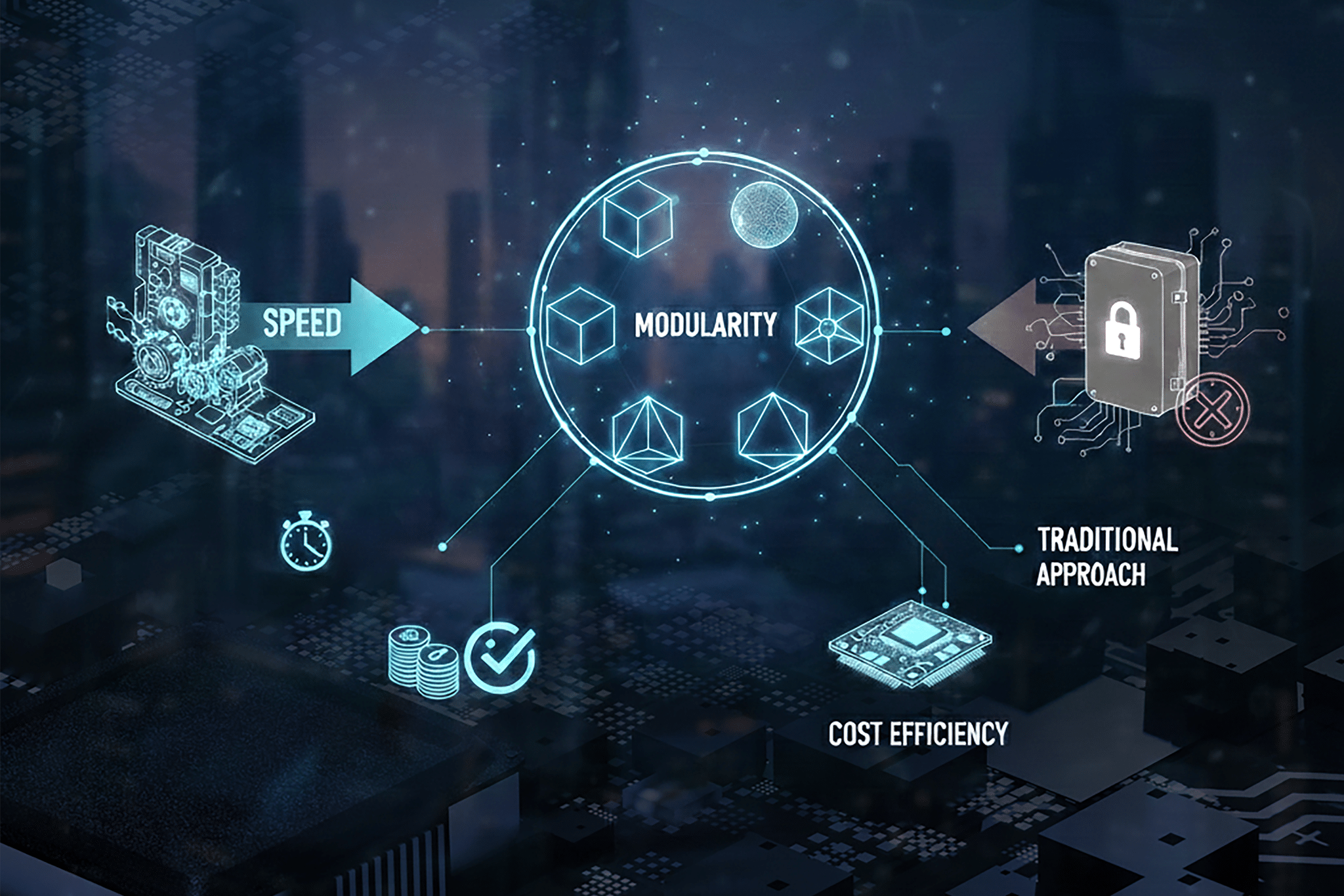
Traditional thinking suggests you must compromise between speed, cost, and quality. We at
Exertus disagree. The solution lies in modular element-based design.
This approach combines the reliability of standard products with the flexibility of customized solutions. It is a strategic method for bringing new machine models to market faster, more cost-effectively, and with technically optimized performance.
Here are three reasons why element-based design is the superior choice for the modern
machine builder.
1. Significantly Shorter Time-to-Market
Time-to-Market is one of the most critical success factors for a new machine model.
Electronics designed entirely from scratch can take years to develop. Adapting standard
components to fit constrained mechanical spaces or working around their software
limitations often causes delays in the later stages of the project.
In element-based design, development does not start from a blank slate. We leverage our
extensive, pre-validated technology platform and firmware layers. Processor cores, I/O
blocks, power supply solutions, and communication buses are established, field-proven
building blocks.
When proven subsystems are reused instead of redesigned, engineering efforts focus solely
on configuring these elements to meet your machine’s specific requirements. This typically
shortens development cycles by 3–6 months compared to ground-up custom electronics and
enables the launch of prototypes and serial production significantly faster than traditional
development approaches.
2. Predictable Project Costs
Custom R&D projects are often associated with budget overruns. Unforeseen technical
challenges and extended validation phases can increase costs beyond initial estimates.
The element-based model introduces cost predictability. Because validated modules are
used, technical risks are substantially reduced. Component behavior and inter-module
communication are already well characterized. This reduces uncertainty and improves the
accuracy of project cost estimates.
Additional savings are achieved on the software side. Exertus’s extensive feature library is
immediately available to developers. Complex algorithms do not need to be implemented
from the ground up, significantly reducing software development effort and associated costs.
3. A Customized, Optimal Solution
Standard controllers often require compromises: they may be physically oversized, include
unnecessary features that increase cost, or lack a critical I/O interface.
With element-based design, you receive a solution optimized specifically for your machine –
not a generalized platform intended for broad use.
- Physical size: Products are more compact than universal competitor models,
simplifying integration into space-constrained machines. - Features: You invest only in the processing capability and interfaces your application
requires. - Flexibility: The solution scales alongside your machine’s lifecycle and future variants.
Summary: Freedom to Create Without Limits
Element-based design is not merely a manufacturing approach; it is a strategy for maintaining business agility. When combined with Exertus’s flexible toolchain—without restrictive license fees or dependence on a single development environment—the result is a tangible competitive advantage.
Do not allow rigid components or resource-intensive development projects to slow your
innovation. Choose a design method built for efficient and reliable market entry.